
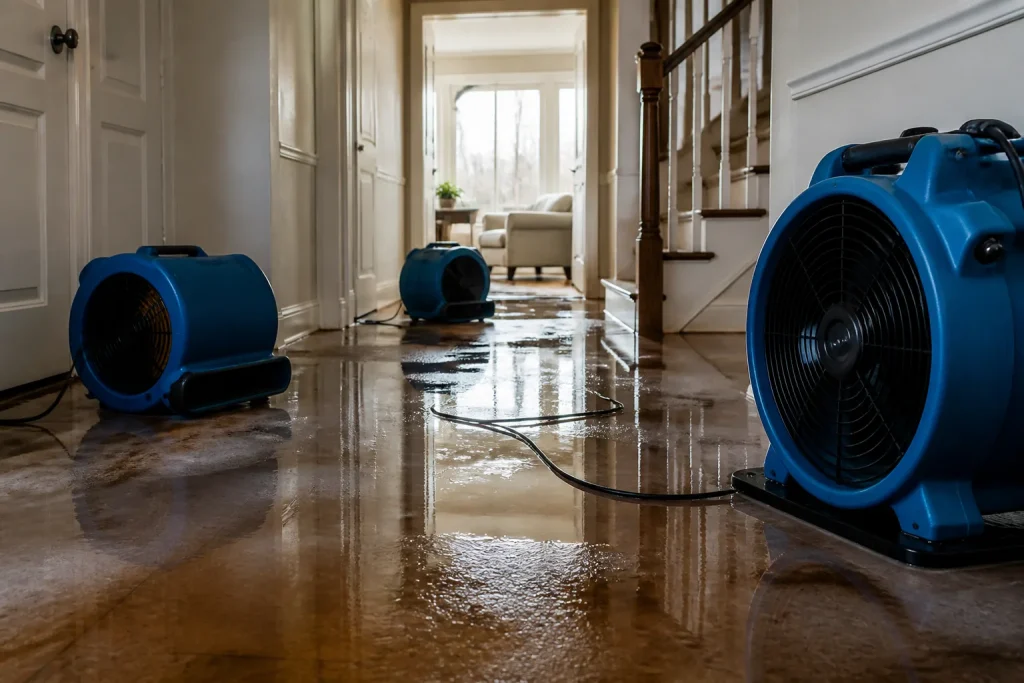
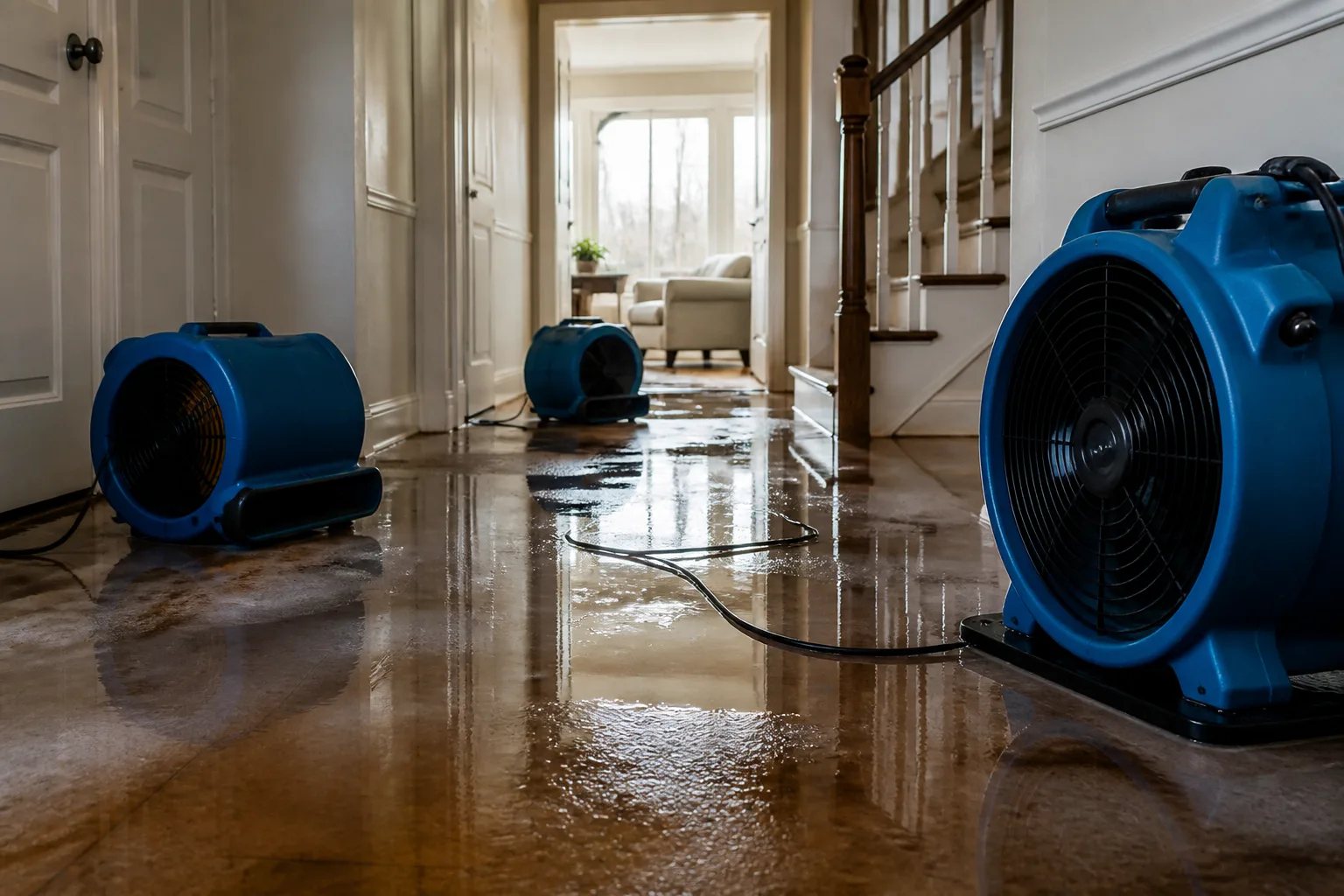
Emergency Water Damage Restoration Near Me: What Secaucus Homeowners Should Do First
The first 90 minutes after water enters your Secaucus home decide whether you’re looking at a $4,000 drying job or a $14,000 rebuild. Most homeowners spend those minutes doing things that feel productive but actually make the restoration harder and more expensive. If you want the short version: shut the water source, kill the power to affected rooms, photograph everything before you move a single item, and call a restoration company that dispatches a live crew the same visit. If you’d rather not sort through the details right now, call Floodline Restoration Co. at (201) 762-0667 and a live dispatcher will walk you through the first steps.
Turning on a box fan is one of the most common first responses to indoor flooding. In a Category 2 or 3 loss, it’s also one of the fastest ways to spread contaminated particulates through your HVAC system and void a portion of your insurance claim. This guide reorders the to-do list by impact, not by instinct.
What Happens in the First 90 Minutes After Water Damage in Secaucus
Water moves fast, but the damage it does moves faster. Sheetrock wicks moisture upward at roughly an inch per hour. Hardwood floors begin cupping within 24 hours. Mold spores that were already in the air settle into wet drywall and start colonizing in 48 to 72 hours. The clock doesn’t care whether the water came from a burst supply line, a failed sump pump, or the Hackensack River backing up into a basement on a heavy storm day.
In Secaucus, we see a few patterns repeat themselves. Homes near the Meadowlands deal with high water tables and sump pump failures. Older homes in the North End have cast-iron drain lines that crack with age. Townhouse developments built in the 1980s and 1990s often share plumbing walls, so a leak in one unit travels into the neighboring unit before anyone notices. None of these are rare, and all of them respond to the same first-90-minutes discipline.
The First 15 Minutes: Shutoffs and Documentation
Do these four things, in this order:
- Stop the water at its source. If it’s a supply line, shut the fixture valve or the main shutoff. If it’s a sewage backup or stormwater, don’t touch the water, and don’t flush toilets or run sinks anywhere in the house. Every drain ties into the same system.
- Cut power to affected rooms only if you can reach the breaker panel without standing in water. If the panel is wet or you’d have to walk through standing water to reach it, call PSE&G and wait. Water and electricity don’t negotiate.
- Photograph the water line on the wall. That line is evidence. It tells the adjuster how high the water reached, which tells the restoration crew how much drywall and insulation has to come out. The line the water left is where we start, and it matters more than any estimate you’ll ever hear.
- Move electronics and valuables off floor level. Phones, routers, laptops, power strips, photo albums, shoes. Takes five minutes. Saves thousands.
Do not wet-vacuum. Do not open windows if the Hudson County humidity is above 50%, which in Secaucus is most of the year. Do not run household fans. We’ll get to why in a minute.
Which Interventions Help, and Which Ones Complicate the Professional Scope
There’s a difference between something that feels productive and something that actually reduces the size of the job. In our 15-plus years serving Secaucus, we’ve walked into hundreds of homes where a homeowner’s first two hours of effort made the final invoice higher than it needed to be.
What genuinely helps
- Shutting the source valve. The single highest-impact action. Nothing else matters until the water stops entering.
- Photographing the water line before it dries. The stain fades as the wall dries, and an adjuster who can’t see the extent of the damage writes a smaller check.
- Recording time-stamped video of the water source. A 30-second phone video of a cracked supply line or a failed sump pump basket is worth more than an hour of written description.
- Saving the failed component. The ruptured washing machine hose, the cracked valve, the burned-out pump. Put it in a plastic bag. If the failure is a manufacturing defect, your carrier may subrogate against the manufacturer. If you throw it away, that option disappears.
- Moving fabric and upholstered items off the floor. Rugs, bottom-of-closet jackets, throw pillows. If it’s wet, set it aside somewhere dry. Don’t launder it yet if it touched Category 2 or 3 water.
What complicates the job
- Wet-vacuuming a sewage or stormwater loss. A shop vac aerosolizes contaminated water. You’re not removing bacteria; you’re putting it into the air.
- Using household fans. A box fan moves water vapor around the room. It doesn’t remove moisture. In a contaminated loss, it pushes pathogens into the HVAC return, the ductwork, and every room on that air handler. Professional drying uses negative air pressure and HEPA filtration to control where the air goes. A box fan does the opposite.
- Opening windows in humid weather. Secaucus sits in a humid subtropical climate. Open windows in July don’t dry anything; they add moisture. Drying is not about airflow. It’s about vapor pressure differential, which is why we run Dri-Eaz and Phoenix dehumidifiers that pull 30 to 130 pints per day, not window fans.
- Pulling wet carpet and pad yourself. Carpet delamination, tack strip damage, and subfloor exposure are all documented differently by adjusters. Let the restoration crew do the removal as part of the documented scope.
How to Document the Loss Correctly for Insurance, Before You Move Anything
The first call you make to your insurance carrier is recorded. The photos you take in the first hour are the evidence that call refers back to. Get the documentation right, and the claim goes smoothly. Get it wrong, and you’re fighting an adjuster who never saw the water line.
Here’s what a proper loss package looks like, based on what we’ve seen help Secaucus homeowners the most:
- Wide shots of each affected room from the doorway. Show the full room so the adjuster can see furniture, flooring type, and the relationship between the water and the walls.
- Close-up shots of the water line on every wet wall. Hold a quarter or a ruler next to the line for scale. The quarter trick feels old-fashioned, but it holds up.
- Time-stamped video of the water source. Start the video by saying the date, the time, and your address. Walk slowly from the source of the water to the farthest point of damage. If the water is still flowing when you film, the timestamped video proves it.
- Photos of the failed component from multiple angles. Serial numbers, brand names, and the point of failure. Then bag the component and keep it.
- Photos of the ceiling below any second-floor bathroom or kitchen. Water travels down through floor joists and shows up on the ceiling below before it shows on the floor above.
- Photos of the electrical panel and water heater area, even if dry. Adjusters look for pre-existing conditions. Documenting them up front heads off questions later.
One more thing: when you talk to the adjuster, describe what happened in plain terms. Don’t speculate about causes you’re not sure of. “The supply line burst under the kitchen sink” is a fact. “The plumbing has been bad since we bought the place” is a guess that invites a coverage dispute. Say what you saw, not what you think it means.
What to Say, and What Not to Say, When You Call Your Insurance Carrier
The sequence most Secaucus homeowners follow is: call the insurance carrier first, wait on hold, answer questions, wait for a call back, then call a restoration company. That sequence routinely delays extraction by four to six hours. Meanwhile, the water is still moving through the wall cavities.
Here’s the better sequence: shut the water, cut the power, photograph everything, call the restoration company, then call the insurance carrier while the crew is on the way. A legitimate 24/7 restoration company doesn’t need the carrier’s permission to start mitigation. Mitigation, which is extraction, drying, and protecting the property from further damage, is covered under the “reasonable and necessary” clause in nearly every homeowner’s policy. The restoration company bills the carrier directly, and the documentation is already underway.
When you do call your carrier, say these things:
- “Water entered the home at [time]. I shut the water source at [time]. I’ve taken photos and video.”
- “I’ve contacted a restoration company to begin mitigation. They’re on the way now.”
- “Please assign an adjuster and send me the claim number by text or email.”
Do not say:
- “It’s probably been leaking for weeks.” This turns a sudden, covered loss into a gradual, possibly excluded maintenance issue.
- “I’ll wait to start anything until the adjuster approves it.” Every hour you wait is another hour of water movement. You have a duty to mitigate under your policy. Document, then act.
- “I’m not sure if it’s covered.” That’s the adjuster’s job to determine, not yours to volunteer.
Curt Bowman has handled enough of these calls to know the pattern: a homeowner calls at 5:30 p.m. on a Friday, waits 45 minutes on hold, gets told an adjuster will call Monday, and then calls us at 9:00 p.m. with water through three rooms and a basement stairway. Call the restoration company first. You’ll be glad you did when the adjuster walks the property and finds the drying already underway, with a moisture log started.
What a Legitimate 24/7 Emergency Response Looks Like
Every restoration company in Hudson County advertises 24/7 emergency response. Very few actually answer the phone with a person at 2 a.m., and even fewer put a crew on the road that visit. Here’s what separates the real thing from a call service that takes a message and schedules the crew for the next morning.
- A live person answers the phone. Not a recording. Not a callback service. A person who can dispatch a crew immediately.
- The crew arrives with extraction equipment in the truck. Professional-grade extraction units, industrial dehumidifiers, air movers, and moisture meters. Not a shop vac and a rental fan.
- The crew starts extraction on the first visit. Extraction should be running within hours of the call, not the next business day. Water damage doesn’t punch a clock.
- The crew documents the job with a moisture map. Day one readings establish the baseline. Daily readings track progress until the dry standard is met. That log goes to you and your carrier. It’s not optional.
- The company bills insurance directly. You have enough to deal with. You shouldn’t be playing messenger between a contractor and a claims department.
At Floodline Restoration Co., we answer the phone with a live dispatcher at all hours. The crew that shows up at your Secaucus home is background-checked, uniformed, and trained to IICRC, RIA, and IFA standards. We run Dri-Eaz, Phoenix, XPOWER, B-Air, and Injectidry equipment, and we hand you a written moisture log at the end. If it’s not done right, the 90-Day Done Right Promise means we make it right. In writing. No arguing.
The Bottom Line
The first 90 minutes after water enters your home determine the scope of the job, the length of the drying period, and whether you’re dealing with a restoration or a rebuild. Shut the water. Cut the power. Document the loss before you move anything. Call a restoration company before you call your insurance carrier. Skip the box fan.
If you’re in Secaucus and need help, Floodline Restoration Co. offers free estimates. Call (201) 762-0667. A live person answers. A certified crew reaches the job the same visit. That’s how we’ve done it since 2010, and that’s how we’ll do it in thirty years.
Related services in Secaucus: Water Damage Restoration in Secaucus, Mold Remediation in Secaucus, Fire & Smoke Damage Restoration in Secaucus. And if you’re still getting oriented, start at the Floodline Restoration Co. home page.
Frequently Asked Questions
A legitimate 24/7 restoration company should reach your home within hours, not the next business day. At Floodline Restoration Co., a live dispatcher answers at 2 a.m., and a certified crew reaches Secaucus homes the same visit, with extraction running before they leave. If a company answers after hours but schedules the crew for the next morning, keep calling. Call (201) 762-0667 and tell us what happened.
Sudden and accidental water damage, like a burst supply line or a failed water heater, is covered under most standard Secaucus homeowner policies. Gradual leaks and flood damage from rising water may not be covered without a separate flood policy. Document the source, the water line, and the failed component before you move anything, and let the restoration company bill your carrier directly. Call (201) 762-0667 for help with documentation and direct insurance billing.
Household fans and small dehumidifiers don’t create enough airflow or remove enough moisture to dry wall cavities, subfloors, and insulation. Water trapped inside a wall won’t dry because a fan is pointed at the surface. Professional drying uses industrial dehumidifiers that pull 30 to 130 pints per day, air movers, and moisture meters to verify the dry standard. In a contaminated loss, household fans actively make the problem worse. Call (201) 762-0667 for a free assessment.
Your restoration company should deal with the adjuster directly, not hand you the paperwork and wish you luck. At Floodline Restoration Co., we document the loss with photos, moisture readings, and a written scope, then bill the carrier directly. You don’t play messenger, and you don’t wait on hold. That’s the way it should work for every Secaucus homeowner, on every job, from first extraction to finished rebuild.
Written by Curt Bowman, Owner at Floodline Restoration Co., serving Secaucus since 2010.
Need Damage Restoration Help?
Call Floodline Restoration Co. - licensed & insured, here with fast after-hours help in Secaucus.
(201) 762-0667