
How to Choose the Right Damage Restoration Company in Secaucus
Choosing a damage restoration company in Secaucus comes down to one question: will one crew own the job from the first extraction through the finished rebuild, or will you be handed off at the drywall stage? Most complaints after a water or fire loss aren’t about bad workmanship. They’re about the seam between two companies who each assumed the other was handling something. If you’d rather not sort through this alone, call Floodline Restoration Co. home at (201) 762-0667 and we’ll walk you through it.
The Handoff Problem Nobody Warns You About
After a water loss, roughly 40% of homeowner complaints to state contractors boards involve the gap between two companies who each thought the other was responsible for a specific scope item. Not fraud. Not shoddy work. Just a seam nobody owned. In Secaucus, where basements flood after heavy rains and the Meadowlands water table keeps the ground damp year-round, that seam is where timelines collapse and insurance disputes multiply.
Here’s how it typically plays out. A mitigation company extracts the water, sets up fans, and leaves after four days. Then a rebuild company arrives, looks at the moisture map, and says the drying wasn’t finished. The mitigation company says it was. The adjuster asks for documentation neither side will produce. You’re now the project manager, making phone calls at 9 p.m. and learning words like “hygroscopic” and “dry standard” against your will.
The fix is simple: ask before you sign anything whether the same company holds both the drying and the rebuild. At Floodline, one crew reads the moisture map on day one, handles daily readings, hands the log to you and your carrier, and rebuilds what needs rebuilding. No handoff. No inherited crew. That’s what full-cycle means in practice.
Five Questions to Ask Before Signing Any Authorization
Most checklists tell you to ask if a company is “certified.” That’s a starting point, not an endpoint. Here are five questions that actually separate a company that will finish the job from one that will disappear after the fans come out.
1. Do the crew members on site hold IICRC WRT and ASD certifications, or just the owner?
The IICRC offers Water Damage Restoration Technician (WRT) and Applied Structural Drying (ASD) certifications. A company can advertise “IICRC-certified” when only the owner holds a paper. The people running the equipment in your kitchen need the training, not the person who answered the phone. Ask for names and certification numbers. A company that hesitates is telling you something.
2. What exactly does “complete restoration” mean in your contract?
Some companies use “complete” to mean they’ll dry the space and then recommend a rebuild crew you’ve never met. Others mean they’ll stay through the finished paint. Ask for the specific scope line by line. If the contract says “mitigation only” or “drying services” anywhere, you’re hiring a company that will hand you off.
3. Who bills the carrier, and who holds the cash flow?
Direct insurance billing matters more than most homeowners realize. A contractor who requires you to collect from the carrier and then pay the contractor puts you in the middle of a cash-flow crunch. You’re waiting on a check while a crew is waiting on payment. That pressure benefits no one but the contractor. A company that bills the carrier directly and waits for the claim to resolve is a company that plans to finish the work.
4. What does your written guarantee actually say?
“Satisfaction guaranteed” is unenforceable. What you want is a guarantee with specific moisture readings, a defined callback period, and a named point of contact. If the paperwork doesn’t include numbers and dates, it’s a marketing slogan. Our 90-Day Done Right Promise, the Keystone Standard, is given in writing with no paperwork battles and no arguing. If it’s not done right, we make it right.
5. Do you have a live person answering the phone, or am I leaving a message?
At 2 a.m. on a Sunday with water spreading across a finished basement in Secaucus, the last thing you need is a voicemail. Call the number on the truck before you need them. If a recording answers, keep looking. We answer with a live dispatcher, every hour, every day. A certified crew reaches the job and extraction is running the same visit.
How to Spot a Mitigation-Only Company (Even When Their Website Says “Complete Restoration”)
Marketing language is cheap. Here’s how to identify a mitigation-only company in Secaucus even when their website promises the world.
- Look at the contract’s scope section. If it lists “drying” or “extraction” but nothing about drywall replacement, flooring, or paint, that’s mitigation. Rebuild scope is a separate line item or a separate company entirely.
- Ask who does the demo. A mitigation crew tears out wet drywall. A rebuild crew hangs new drywall. If you have to ask “so who actually puts this back together?” and the answer is “we’ll connect you with someone,” you’re looking at a handoff.
- Check the equipment list. A company that only owns air movers and dehumidifiers is a drying company. A company that also owns Injectidry systems for hardwood floors, XPOWER commercial air movers, and B-Air dryers, and has a rebuild division, is a full-cycle operation.
- Ask for one contract, one crew, one log. If the moisture readings come from one company and the rebuild quote comes from another, you’re managing a seam. We keep one moisture log from day one until the dry standard is met, and the same crew that reads that map handles the rebuild.
In Secaucus specifically, the post-storm market attracts crews with out-of-state plates who show up after every heavy rain event. They do extraction and leave. Then the rebuild contractors who actually live in Hudson County get the call when you realize the drying was incomplete. Ask where the company is based. A company that plans to be in town in thirty years hires local, trains apprentices into journeymen, and answers the phone with a person.
Red Flags Specific to the Post-Storm Secaucus Market
Secaucus sits in a flood-prone pocket of Hudson County, bordered by the Hackensack River and the Meadowlands. After a heavy storm, the same pattern repeats: trucks with out-of-state plates appear, estimates are verbal, and homeowners feel pressured to sign immediately because “the insurance company requires it today.”
Slow down. Your insurance company does not require you to sign with the first crew that knocks on your door. Here’s what to watch for in Secaucus specifically.
- Verbal-only estimates. A square deal is written down. If a crew won’t put numbers on paper before starting, they won’t put them on paper after, either.
- “The insurance company requires it today.” They don’t. Your policy requires you to mitigate further damage, not to sign with a specific contractor within the hour. Take the time to call a company with local roots.
- No local references. Ask for a job they completed in Secaucus, North Bergen, or Kearny in the last six months. A company that’s been in business for years can name streets, not just zip codes.
- A truck wrapped in vinyl and a different phone number than the website. Storm chasers change branding often. Look for a physical address in Hudson County and call the number on the website before you sign anything.
We pulled a water heater out of a finished basement over on Flanagan Way last month where the homeowner had been told by a storm-chasing crew that the whole room needed gutting. Turned out the floor joists were dry, the drywall was salvageable above the waterline, and the crew had never taken a moisture reading below the carpet. We dried it in four days. The bill was a third of the quote. That’s the difference between a company that sells demolition and a company that reads the moisture map.
What a Written Guarantee Should Actually Contain
Most guarantees in this industry are vague enough to be unenforceable. Here’s what a real one looks like, and what to demand before you sign.
- Specific moisture readings. The guarantee should reference a dry standard, like “wood moisture content below 12% and no visible microbial growth,” and confirm those readings were logged daily and shown to the homeowner and carrier.
- A defined callback period. “If anything comes back, call us” isn’t a guarantee. “If any treated area fails within 90 days, we return and make it right at no cost” is.
- A named point of contact. You should know the name of the person who owns the problem if something goes wrong. At Floodline, that’s Curt Bowman. Not a department, not a ticket number. A person with a phone.
- The equipment used. A guarantee is only as good as the drying. We use Dri-Eaz, Phoenix, XPOWER, B-Air, and Injectidry equipment, moisture-mapped from day one with daily readings logged until the dry standard is met. The guarantee references that log.
If a company’s guarantee is a single sentence with the word “satisfaction” in it, ask what happens when you’re not satisfied. The silence after that question is your answer. Our 90-Day Done Right Promise, the Keystone Standard, is tied to a values code we call K.E.Y.S.: Krafted right, Every time, Your home first, Standing behind it. That’s not a slogan. It’s what goes into writing before you sign.
Why the Equipment Matters More Than You Think
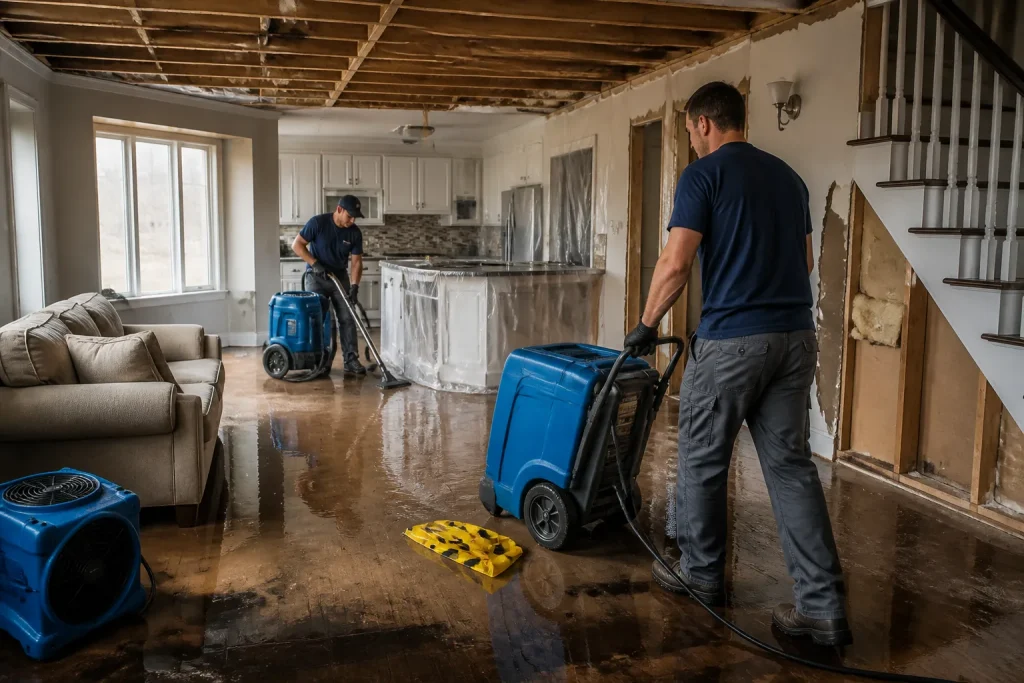
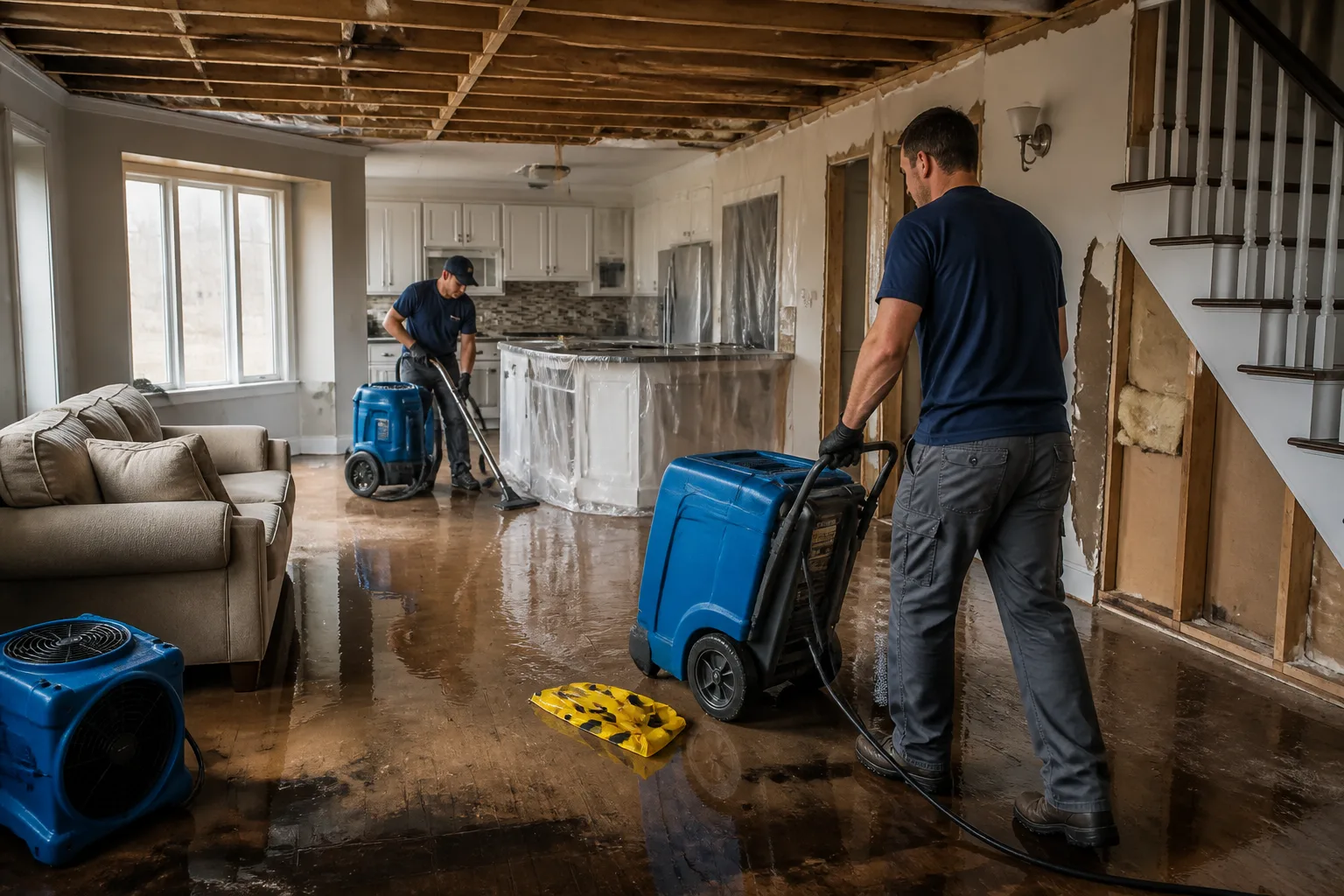
Professional-grade equipment isn’t a detail. It’s the difference between a basement that dries in four days and one that molds in two weeks. The brands you see on our trucks, Dri-Eaz, Phoenix, XPOWER, B-Air, are commercial systems designed for structural drying, not rental units from a hardware store. We use Injectidry systems for hardwood floors that would otherwise need replacing in a Secaucus flood.
Here’s why it matters. A house with a flooded basement in Secaucus needs air movement measured in cubic feet per minute, not “a couple of fans running.” The dry standard requires specific humidity ratios, surface temperature readings, and daily moisture logging. Amateur equipment moves air around. Professional equipment removes water from materials before the mold has a chance to start. When you’re comparing quotes, ask what brand of dehumidifier they’re bringing. If the answer is “industrial” with no name, ask again.
You don’t need to become a hydrologist. You just need to know that the company you hire owns the equipment, knows how to read the data, and hands you the log. Not promises. Numbers, dated and signed.
Related Services in Secaucus
If you’re dealing with water in your basement, start with Water Damage Restoration in Secaucus. If you’ve found mold or suspect it behind walls, see Mold Remediation in Secaucus. And if you’ve had a fire or heavy smoke, our Fire & Smoke Damage Restoration in Secaucus page explains the process from board-up through rebuild.
What happens when you call
- 1
A real person answersNo phone trees - you reach a local pro.
- 2
You get an upfront price rangeHonest numbers before anyone is dispatched.
- 3
A background-checked tech heads outLicensed & insured, dispatched right away.
- 4
You approve before work beginsNothing starts until you say go.
The Bottom Line
The company you choose after a water, fire, or mold loss in Secaucus determines whether you’re back in your home in weeks or arguing about moisture readings in months. Ask who holds the certifications on the crew actually doing the work. Ask whether one company owns the job from extraction through rebuild. Ask for a written guarantee with numbers, dates, and a name. And ask who answers the phone at 2 a.m.
If you’re in Secaucus and need help, Floodline Restoration Co. offers free estimates. Call (201) 762-0667 and you’ll speak to a live dispatcher, not a recording. We’ll be there when we say.
Frequently Asked Questions
A company with live 24/7 dispatch can have a certified crew on site within hours, and extraction running the same visit. At Floodline, a live dispatcher answers at 2 a.m., and our crews are based locally in Hudson County, so we’re not driving in from another state. The faster water is extracted, the less damage spreads. Call (201) 762-0667 and ask what time a crew can arrive.
Most homeowners policies in New Jersey cover sudden and accidental water damage, though flood damage from rising water requires a separate flood policy. The key is documentation: photo records, daily moisture logs, and a written scope of work. We bill your carrier directly and coordinate with your adjuster so you don’t have to play messenger. Call (201) 762-0667 for a free estimate and we’ll help you understand what your policy covers.
That depends on how far the water traveled and what materials absorbed it. If water touched drywall, baseboards, or carpet padding, those materials trap moisture and need professional drying or removal. A quick mop-up leaves moisture inside the wall cavity, and that’s where mold starts. A free assessment with moisture readings will tell you what actually needs to happen, nothing more, nothing less. Call (201) 762-0667 to schedule one.
The cheapest bid often comes with a handoff at the drywall stage, equipment that can’t reach the dry standard, and a guarantee that isn’t worth the paper it’s written on. You’re not buying a service. You’re buying a result: a dry house with documentation your carrier will accept. The most expensive mistake is paying twice because the drying wasn’t done right the first time. Ask for a written scope, a written guarantee, and a named contact. If all three are clear, price is the last variable, not the first.
Written by Curt Bowman, Owner at Floodline Restoration Co., serving Secaucus since 2010.
Need Damage Restoration Help?
Call Floodline Restoration Co. - licensed & insured, here with fast after-hours help in Secaucus.
(201) 762-0667